



Do you ever feel like your heating and cooling costs keep climbing for no apparent reason? It’s a common frustration. In many properties, HVAC systems account for 40% to 60% of total energy consumption. Because of this, even smart, minor adjustments can make a noticeable dent in your monthly bill—whether you’re managing an office, a home, or a retail space.
Optimizing your HVAC operation doesn’t always require a huge capital investment. In most cases, strategic thermostat settings are enough to save energy without giving up thermal comfort. We’ve put together this practical guide with tips to help you save energy and keep your HVAC equipment running at its best.
Why Proper Thermostat Settings Matter?
Think of the thermostat as the “brain” of your HVAC system. It decides when to kick on, when to heat or cool, and when to end the cycle. Poor configuration doesn’t just hurt your comfort; it wastes energy, accelerates equipment wear, and forces your compressor or furnace to work harder than necessary.
Common consequences of a poorly adjusted thermostat include:
- Short Cycling: Constant starting and stopping that reduces the equipment’s lifespan.
- Discomfort: Spaces that never feel quite right.
- High Bills: Elevated costs even during mild weather seasons.
- Overworking: Equipment running excessively due to conflicting instructions or operating after hours.
Paying attention to your thermostat is one of the most cost-effective moves for any property stakeholder, from homeowners to facility managers and maintenance supervisors.
Practical DIY Tips for Energy Savings
Here are some energy-saving moves you can make right now without needing specialized tools.
Adjust for Occupancy Schedules
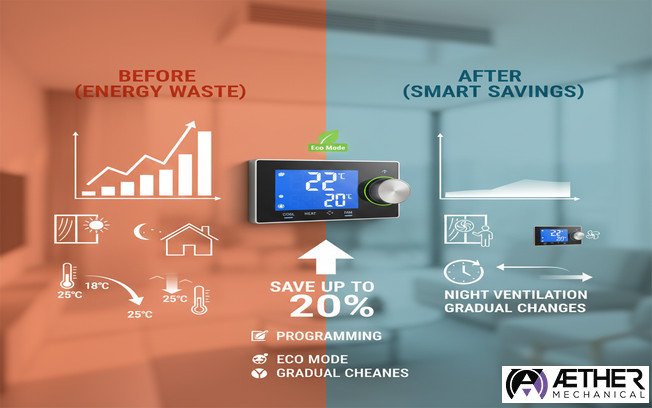
Scheduling is one of the most underused features on modern thermostats. Matching temperatures to the building’s actual usage hours can yield savings of 10% to 20% without compromising comfort.
Recommendations:
- Occupied Hours: Keep temperatures in recommended ranges (e.g., 68–70°F in winter and 74–76°F in summer).
- Unoccupied Hours: Adjust the temperature by 6–8 degrees (setback) to reduce the system’s load.
- Commercial Spaces: For offices or shared properties, 7-day schedules prevent the system from running needlessly at night, on weekends, or during holidays.
- The “Always On” Myth: Avoid the temptation to “leave the AC on” all day thinking it’s more efficient. In most properties, controlled setbacks generate greater savings.
Utilize Energy-Saving Modes
Smart thermostats and many digital models include “Eco” or “Energy Saver” modes designed to maximize efficiency. These functions include:
- Occupancy Sensing: Automatically turns off or adjusts the system if it detects the space is empty.
- Learning Capabilities: Advanced models analyze usage patterns and adjust the system without manual intervention.
- Geofencing: Lowers consumption once all occupants have left the property.
- Maintenance Alerts: Reminders for filter changes and notifications of abnormal equipment behavior.
These features help eliminate common human errors and improve how the system responds to changing weather.
Leverage Natural Night Cooling
In temperate or dry climates, outside temperatures drop significantly at night. This offers a chance to cool interiors without running the AC compressor.
Recommended Actions:
- Open windows or skylights at night to flush the space with fresh air.
- Run the HVAC fan (fan-only mode) to circulate air without activating the cooling stage.
- Close up the property early in the morning to trap the cool air inside.
This approach is especially effective for properties with high ceilings or excellent cross-ventilation.
Avoid Drastic Temperature Swings
Cranking the thermostat way up or down doesn’t heat or cool the space faster; it just forces the system to run at maximum capacity for longer periods.
Best Practices:
- Make gradual adjustments of 1–2°F.
- Define an ideal range to avoid constant fiddling.
- Educate occupants or staff to avoid impulsive changes that hurt efficiency.
Small, sustained changes yield better results than extreme, inconsistent modifications.
When DIY Isn’t Enough: Common Limitations
While these tips are helpful, there are situations where tweaking the thermostat yourself won’t guarantee results.
Common underlying issues include:
Improper Calibration
A miscalibrated thermostat may display a temperature different from the actual room temperature, leading to inefficient cycling and excessive energy use.
Incorrect Installation
Location is crucial. Frequent installation errors include placing the thermostat:
- Near sunny windows.
- Above heat-generating appliances.
- On exterior walls.
- In drafty areas or near entryways.
These positions confuse the sensors and cause erroneous readings.
Sudden Weather Shifts
Basic, non-smart models react slowly to abrupt weather changes, resulting in discomfort or higher-than-expected consumption. In these cases, professional intervention is key to restoring HVAC performance.
Thermostat Efficiency FAQ
What is the best temperature for saving energy in winter?
We recommend keeping the thermostat between 64.4°F and 68°F when occupied, and lowering it to roughly 60.8°F when the space is empty.
How do I know if my thermostat is miscalibrated?
If you notice a difference between the actual room temperature and the thermostat reading, or if the system short-cycles frequently, it likely requires calibration.
Is a smart thermostat worth the investment?
Yes. Modern models allow for automatic scheduling, occupancy detection, and remote control, all of which can significantly reduce energy consumption.
How Aether Mechanical Can Help
At Aether Mechanical, we understand that energy efficiency isn’t just about the thermostat—it’s about the correct integration of the entire HVAC system. That’s why we offer solutions designed to maximize performance for both residential and commercial properties:
- Professional Calibration: We ensure the thermostat reads true temperatures and triggers the correct cycles.
- Smart Thermostat Recommendations & Installation: We work with trusted brands like Daikin and models adaptable to different property types. We recommend the ideal option based on your usage habits, property size, and savings goals.
- Verified Installation: We guarantee optimal placement, safe wiring, and full compatibility with your HVAC system.
- Full System Integration: We ensure the thermostat communicates correctly with your equipment, preventing inefficient cycling and optimizing the unit’s lifespan.
Aether Mechanical is distinguished by honesty, rapid response times, and a focus on high-efficiency solutions—values that have established us as a trusted partner in the Denver metro area.
Small Adjustments, Big Savings
The right combination of smart adjustments, energy-saving modes, and strategic programming can transform a property’s energy consumption without compromising comfort.
If you want to ensure optimal performance for your HVAC system, we invite you to schedule a professional evaluation. At Aether Mechanical, we can help you choose, calibrate, and install the ideal thermostat, as well as optimize your entire system to reduce energy costs year-round.
Want to improve your property’s comfort and lower your energy expenses? Contact us today to request a diagnostic.


